


TMT Test: What It Detects, How to Prepare & Results
A TMT test short for Treadmill Test is a cardiac stress test that evaluates how well the heart responds to physical exertion by monitoring heart rate, blood pressure, and ECG readings while the patient walks on a treadmill at progressively increasing speed and incline. It is one of the most widely used diagnostic procedures for detecting coronary artery disease, assessing cardiovascular fitness, and identifying abnormal heart activity that only becomes apparent when the heart is under physical stress. Cardiologists and cardiac diagnostic specialists at SRM Global Hospitals in Chennai use the TMT test as a key tool for early detection of heart conditions that may not be visible on a resting ECG.
What Is a TMT Test?
A TMT test also called a treadmill test, exercise stress test, or cardiac stress test is a non-invasive diagnostic procedure that assesses the heart’s response to controlled physical stress.
At rest, the heart may function normally even in the presence of significantly narrowed coronary arteries. However, during physical activity, the heart muscle demands more blood and oxygen. If the coronary arteries are partially blocked, this increased demand reveals poor blood flow patterns and reduced blood flow to the heart muscle producing changes in ECG readings, heart rate, and blood pressure that indicate underlying coronary artery disease.
The TMT test helps identify these abnormalities in heart function that may not be apparent when the body is at rest, making it crucial for early detection of heart conditions and coronary artery disease before they cause a serious cardiac event.
The TMT test is also referred to as:
Treadmill test
Treadmill test TMT
Exercise stress test
Cardiac stress test
TMT treadmill test
Stress test
Why Is a TMT Test Done?
The TMT test is primarily conducted to detect coronary artery disease and assess cardiac function by evaluating how well the heart responds to physical stress. Cardiologists at SRM Global Hospitals recommend a TMT test when a patient’s symptoms, risk factors, or resting ECG findings suggest the possibility of underlying coronary artery disease or impaired cardiac function.
By monitoring heart rate, blood pressure, and ECG responses during exercise, the TMT test provides valuable insights into how well the heart is receiving blood and oxygen during physical activity information that a resting ECG simply cannot provide
Common Reasons for a TMT Test
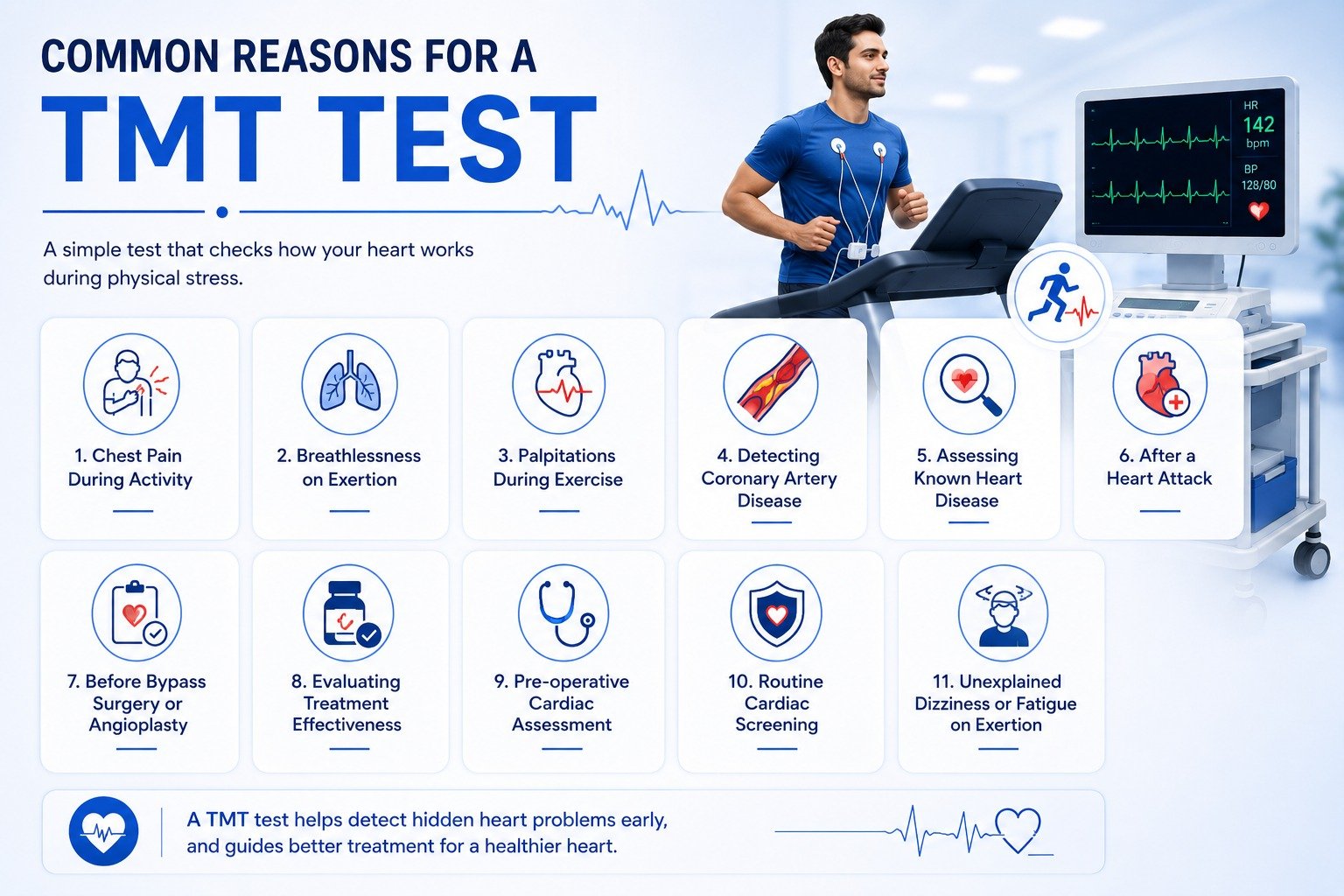
Chest pain during physical activity — to determine whether experiencing chest pain on exertion is caused by reduced blood flow from blocked coronary arteries
Shortness of breath on exertion — to assess whether poor blood flow to the heart muscle is causing breathlessness during physical activity
Palpitations during exercise — to identify whether irregular heart rhythms are triggered by physical exertion and elevated heart rate
Detecting coronary artery disease — to confirm or rule out significant narrowing in the coronary arteries in patients with intermediate risk factors
Assessing known coronary artery disease — to evaluate the functional severity of existing blockages and assess how the heart responds to physical stress
After a heart attack — to assess exercise tolerance, cardiovascular fitness, and the safety of returning to physical activity
Before bypass surgery or angioplasty — to evaluate cardiac function and exercise capacity before a planned intervention
Evaluating treatment effectiveness — to assess whether medications or bypass surgery have improved blood flow and restored normal heart function during physical exertion
Pre-operative cardiac assessment — required before major surgical procedures to evaluate cardiovascular fitness and identify any certain risks that need management
Routine cardiac screening — for individuals with risk factors such as high blood pressure, diabetes, family history of heart disease, high cholesterol, or a sedentary lifestyle
Unexplained dizziness or fatigue on exertion — to rule out cardiac causes of symptoms that appear only during physical activity
Who Typically Needs a TMT Test?
A TMT is typically recommended for individuals with an intermediate risk profile or those experiencing concerning symptoms during daily activities. The tmt test is needed when:
Patient Profile | Why a TMT Test Is Recommended |
|---|---|
Intermediate cardiac risk with chest pain | To directly assess whether physical stress reveals reduced blood flow |
Known coronary artery disease | To evaluate functional severity and cardiovascular fitness |
Family history of early heart disease | For early detection before symptoms develop |
High blood pressure with exertional symptoms | To assess how blood pressure and ecg respond during physical activity |
Post heart attack recovery | To assess exercise tolerance before resuming physical activity |
Before bypass surgery planning | To evaluate cardiac function under controlled physical exertion |
Unexplained irregular heart rhythms | To check whether irregular heart rhythms are triggered by physical stress |
How Is a TMT Test Performed?
The TMT test procedure is typically performed in a dedicated cardiac diagnostic laboratory at SRM Global Hospitals under continuous medical supervision by trained cardiologists and medical professionals. The entire procedure, including preparation and recovery, takes around 30 to 45 minutes.
Before the TMT Test Preparation
Cardiologists and medical professionals at SRM Global Hospitals provide personalised preparation instructions before the tmt test is performed. Key preparation guidelines include:
Avoid heavy meals: Skip heavy meals, tea, or coffee at least three to four hours before the TMT test. Eating a large meal before the tmt test take can cause discomfort during exercise and affect accurate evaluation of heart rate and blood pressure responses.
Avoid caffeinated beverages: Avoid eating or drinking caffeinated beverages including tea, coffee, and energy drinks for a few hours before the TMT test. Caffeine can elevate heart rate and blood pressure artificially, interfering with accurate monitoring of the heart’s response during the procedure.
Water is allowed: Drinking water before the tmt test is allowed and recommended to avoid dehydration during treadmill exercise.
Wear proper footwear: Patients should wear comfortable clothing and proper sports shoes or walking shoes for the TMT test. Avoid sandals, formal shoes, or high heels these create a risk of falls and restrict natural movement during treadmill exercise.
Medication review: Inform the cardiologist about all current medications before the tmt test is done. Certain medications particularly beta blockers and anti-anginal drugs affect heart rate and blood pressure responses during exercise and may need to be temporarily paused under medical supervision.
Medical history disclosure: Share complete medical history including previous heart attack, bypass surgery, known coronary artery disease, high blood pressure, and any recent cardiac symptoms with the cardiologist before the tmt test is performed.
Avoid smoking: Refrain from smoking for at least three hours before the tmt test, as nicotine affects heart rate and blood pressure responses.
During the TMT Test Step by Step
The TMT test procedure is closely monitored throughout by cardiologists and medical professionals at SRM Global Hospitals.
Step 1 — Baseline readings: Before the patient begins walking, the medical team takes baseline readings of heart rate, ECG readings, and blood pressure while at rest. These baseline values are used as the reference point against which all exercise readings are compared throughout the tmt test.
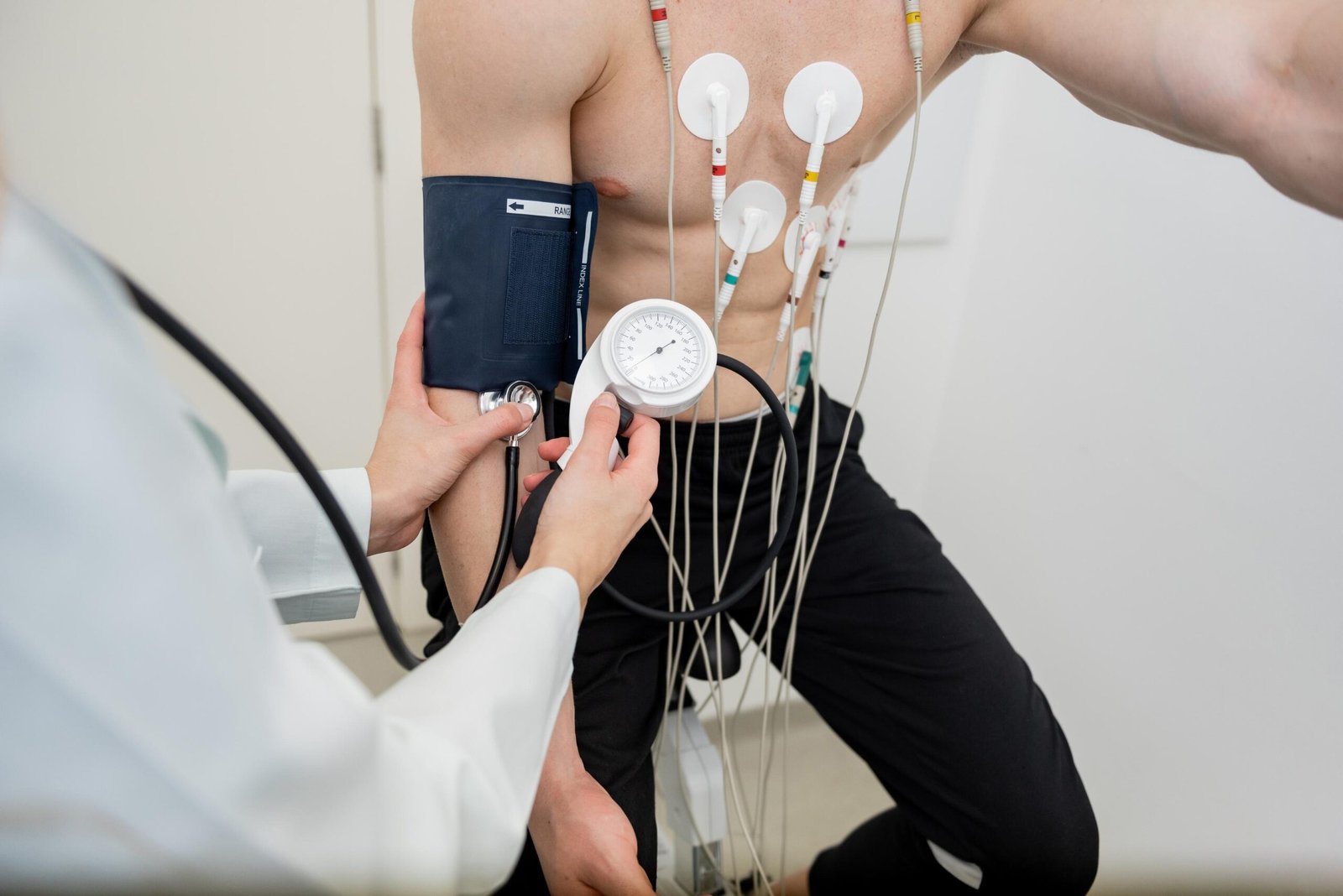
Step 2 — Electrode placement: Electrodes are placed on the patient’s chest to monitor heart activity and capture continuous ECG readings throughout the test. A blood pressure cuff is also fitted to monitor blood pressure at regular intervals during the treadmill exercise.
Step 3 — Treadmill exercise begins: The patient begins walking on the treadmill at a slow, comfortable pace. The treadmill speed and incline are increased every few minutes following the standard Bruce Protocol — to gradually increase the physical stress on the heart. This progressive increase in speed and incline allows cardiologists to observe how the heart responds to each level of physical exertion.
Step 4 — Continuous monitoring: Throughout the tmt test, the patient’s heart rate, blood pressure, and ECG readings are continuously monitored and displayed in real time. Medical professionals closely monitor the patient for any symptoms including chest pain, dizziness, significant irregular heart rhythms, or dangerous changes in blood pressure and ecg that would require the test to be stopped immediately.
Step 5 — Target heart rate: The goal of the tmt test is to reach a target heart rate typically 85% of the maximum predicted heart rate for the patient’s age which represents sufficient physical stress to reveal any reduced blood flow or abnormal cardiac responses that would not appear at rest.
Step 6 — Recovery monitoring: Once the target heart rate is achieved or the TMT test is stopped, the patient continues to be closely monitored during the recovery phase. Heart rate, blood pressure, and ECG readings are recorded as they return toward baseline values. Abnormal findings during recovery are also clinically significant and form part of the TMT test results interpretation.
The TMT test typically lasts between 10 to 15 minutes of exercise on the treadmill, while the entire procedure including preparation and recovery takes around 30 to 45 minutes.
When Is the TMT Test Stopped Early?
The TMT test is stopped early by the medical team if any of the following occur during treadmill exercise under medical supervision:
Significant chest pain or severe experiencing chest pain
Dangerous drop or excessive rise in blood pressure
Severe irregular heart rhythms on ECG readings
Signs of poor blood flow or reduced blood flow on the ECG monitor
Extreme shortness of breath or dizziness
Patient requests to stop due to fatigue or discomfort
TMT Test Results: What They Mean
The interpretation of TMT test results considers various factors including the patient’s medical history, symptoms, and the heart’s behavior during the test including heart rate and blood pressure responses, ECG readings changes, and exercise tolerance achieved.
Negative TMT Test Result
A negative TMT test result also called a normal TMT test suggests that the heart’s response to exercise is normal, indicating a lower likelihood of underlying coronary artery disease or other cardiac issues.
In a negative tmt test:
Heart rate and blood pressure rise appropriately during treadmill exercise and return to normal range during recovery
ECG readings show no significant changes indicating poor blood flow or reduced blood flow to the heart muscle
No chest pain, dizziness, or significant irregular heart rhythms are experienced
The patient achieves a good level of cardiovascular fitness and exercise tolerance
A negative tmt test result provides reassurance about cardiac health. However, cardiologists at SRM Global Hospitals correlate the result with the patient’s complete medical history, symptoms, and risk factors before closing the evaluation.
Positive TMT Test Result
A positive TMT test result indicates that the heart is not receiving enough blood supply under stress, which may suggest blockages in the coronary arteries.
In a positive tmt test:
Characteristic changes in ECG readings particularly ST-segment depression indicate reduced blood flow to the heart muscle during physical exertion
Abnormal heart rate or blood pressure responses occur during treadmill exercise
Chest pain, significant irregular heart rhythms, or dizziness are triggered by physical stress
Exercise tolerance is significantly reduced, with the patient unable to reach the target heart rate
A positive tmt test does not confirm coronary artery disease with certainty it indicates a significant probability that further tests are required for a definitive diagnosis. Cardiologists at SRM Global Hospitals will typically recommend coronary angiography or advanced cardiac imaging as further tests following a positive tmt test result.
Inconclusive TMT Test Result
In some cases, the tmt test results are inconclusive the patient does not reach the target heart rate due to physical limitations, certain medications affecting heart rate responses, or technical factors. In such cases, cardiologists may recommend an alternative form of cardiac stress test such as a pharmacological stress test or stress echocardiogram for accurate evaluation.
TMT Test Results Interpretation Summary
TMT Test Result | What It Indicates | Next Steps |
|---|---|---|
Negative (Normal) | Heart responds normally to physical stress lower likelihood of coronary artery disease | Reassurance; lifestyle and risk factor management |
Positive | Reduced blood flow detected under stress possible blockages in coronary arteries | Further tests coronary angiography, stress echo |
Inconclusive | Target heart rate not achieved results not definitive | Alternative stress testing pharmacological stress test |
Strongly Positive | Significant ST changes at low workload high-risk coronary artery disease likely | Urgent referral coronary angiography, possible bypass surgery |
Is the TMT Test Safe?
The TMT test is generally safe and is one of the most widely tmt test performed cardiac diagnostic procedures globally. It is conducted under continuous medical supervision by experienced cardiologists and medical professionals at SRM Global Hospitals, with full cardiac monitoring and emergency equipment readily available throughout the procedure.
While the TMT test is generally safe, there are certain risks that cardiologists discuss with each patient before the procedure:
Minor side effects: Some individuals may experience minor side effects such as dizziness or fatigue during treadmill exercise. These are generally short-lived and resolve quickly during the recovery phase under medical supervision.
Risk of falls: There is a slight risk of falls or injuries during the treadmill exercise, particularly for individuals with balance issues or mobility limitations. Trained medical professionals are present throughout the tmt test to ensure patient safety.
Serious complications: Serious complications from the TMT test are rare due to continuous medical supervision and careful patient selection. Cardiologists at SRM Global Hospitals carefully screen each patient before the tmt test is done to identify any certain risks.
Who Should Not Have a TMT Test?
Patients with pre-existing severe heart conditions, uncontrolled hypertension, or a recent heart attack may not be suitable candidates for the TMT test. The tmt test is not performed on patients with:
Severe uncontrolled high blood pressure at rest
Unstable chest pain or a recent heart attack within the past 48 hours
Severe heart failure or significantly reduced cardiac function
Dangerous irregular heart rhythms at rest
Severe aortic stenosis or other obstructive valve conditions
In such cases, cardiologists at SRM Global Hospitals recommend alternative diagnostic procedures such as pharmacological stress testing or coronary angiography that do not require physical exertion.
TMT Test vs. Other Cardiac Stress Tests
Cardiologists at SRM Global Hospitals select the most appropriate form of cardiac stress testing based on the patient’s physical condition, medical history, and diagnostic requirements.
Test | How Stress Is Applied | Best Used For |
|---|---|---|
TMT Test (Treadmill Test) | Treadmill exercise with increasing speed and incline | Detecting coronary artery disease in patients able to exercise |
Stress Echocardiogram | Treadmill exercise + real-time echo imaging | Assessing wall motion abnormalities alongside blood flow |
Pharmacological Stress Test | Certain medications simulate exercise effects on heart rate | Patients unable to perform treadmill exercise |
Nuclear Stress Test | Treadmill or pharmacological stress + nuclear imaging | Detailed blood flow mapping of coronary arteries |
Get Your TMT Test Done at SRM Global Hospitals — Book an Appointment
SRM Global Hospitals in Chennai provides comprehensive TMT test and cardiac stress testing services, performed under continuous medical supervision by experienced cardiologists with state-of-the-art cardiac monitoring equipment.
TMT test (treadmill test) performed under continuous ECG, heart rate, and blood pressure monitoring by experienced cardiologists
Comprehensive tmt test results interpretation with full clinical context correlating ECG readings, blood pressure responses, and exercise tolerance
Stress echocardiogram combining treadmill exercise with real-time echo imaging for accurate evaluation of coronary artery disease
Pharmacological stress testing for patients not suitable for treadmill exercise due to physical limitations or certain medications
Coronary angiography for patients with a positive tmt test requiring further tests and definitive coronary artery disease assessment
Post-test counselling with cardiologists explaining tmt test results, risk factors, and the next steps in cardiac management
Cardiac health packages including TMT test for routine cardiac screening in individuals with high blood pressure, family history, or intermediate cardiac risk
Emergency-ready cardiac diagnostic environment with full medical supervision and resuscitation equipment throughout every tmt test performed
FAQs on TMT Test
1. What Is a TMT Test and What Does It Detect?
A TMT test or treadmill test is a cardiac stress test that monitors heart rate, blood pressure, and ECG readings while the patient exercises on a treadmill at increasing speed and incline. It is primarily used for detecting coronary artery disease by revealing poor blood flow and reduced blood flow to the heart muscle under physical stress. The TMT test helps identify abnormalities in heart function and irregular heart rhythms that do not appear on a resting ECG, making it valuable for early detection of heart conditions.
2. How Long Does a TMT Test Take?
The TMT test typically lasts between 10 to 15 minutes of exercise on the treadmill. The entire procedure, including preparation, baseline readings, treadmill exercise, and recovery monitoring, takes around 30 to 45 minutes. Patients can typically return home the same day after the tmt test is done and the recovery phase is completed under medical supervision.
3. What Does a Positive TMT Test Result Mean?
A positive TMT test result indicates that the heart is not receiving enough blood supply under physical stress, suggesting possible blockages in the coronary arteries. During the treadmill exercise, characteristic changes in ECG readings particularly ST-segment depression alongside chest pain, abnormal blood pressure responses, or irregular heart rhythms indicate a positive tmt test. A positive tmt test result requires further tests typically coronary angiography to confirm the diagnosis and assess the extent of coronary artery disease.
4. How Should I Prepare for a TMT Test?
Patients should avoid heavy meals, tea, or coffee for at least three to four hours before the TMT test. Drinking water is allowed. Avoid caffeinated beverages for a few hours before the test. Wear comfortable clothing and proper sports shoes or walking shoes not sandals or formal footwear. Inform the cardiologist at SRM Global Hospitals about all current medications, particularly certain medications like beta blockers that affect heart rate responses. Share your complete medical history including any history of heart attack, bypass surgery, or high blood pressure.
5. Is the TMT Test Painful or Dangerous?
The TMT test is generally safe and a non-invasive diagnostic procedure. It involves physical exertion on a treadmill, which may cause tiredness, breathlessness, or minor side effects such as dizziness in some patients these are expected responses and are closely monitored by medical professionals. Serious complications from the TMT test are rare, as the procedure is continuously monitored with full cardiac supervision and emergency equipment available. Patients with certain risks or pre-existing severe heart conditions are carefully screened before the tmt test is performed.
6. What Is the Difference Between a TMT Test and an ECG Test?
A resting ECG test records the heart’s electrical activity while the patient is at rest, in a static state. The TMT test treadmill test records ECG readings, heart rate, and blood pressure continuously while the patient exercises at increasing speed and incline on a treadmill. The key difference is that the TMT test reveals how the heart responds to physical stress, detecting reduced blood flow and coronary artery disease that may be completely invisible on a resting ECG. Cardiologists at SRM Global Hospitals often use both tests together for a complete cardiac evaluation.
7. Who Should Not Have a TMT Test?
Patients with uncontrolled high blood pressure, a recent heart attack, severe heart failure, dangerous irregular heart rhythms at rest, or severe valve conditions should not undergo a standard TMT test. The TMT test is not suitable for patients unable to perform treadmill exercise due to physical limitations or mobility issues. Cardiologists at SRM Global Hospitals assess each patient’s medical history and risk profile to determine whether the TMT test is needed and safe, or whether an alternative cardiac stress test is more appropriate.
8. Can a TMT Test Miss Coronary Artery Disease?
A TMT test has a good but not perfect accuracy for detecting coronary artery disease. A negative tmt test result significantly reduces the likelihood of significant coronary artery disease but does not eliminate it entirely. False negative results can occur in patients with single-vessel disease or in cases where the target heart rate is not achieved. For patients with strong risk factors or persistent symptoms despite a negative TMT, cardiologists at SRM Global Hospitals may recommend further tests such as a stress echocardiogram or coronary angiography for accurate evaluation.
9. What Happens After a Positive TMT Test?
After a positive tmt test result, cardiologists at SRM Global Hospitals will discuss the findings and recommend appropriate further tests and management. Depending on the degree of positivity and the patient’s clinical profile, next steps may include coronary angiography to directly visualise the coronary arteries and confirm blockages, pharmacological optimisation with medications for coronary artery disease, or referral for bypass surgery or angioplasty if significant coronary artery disease is confirmed. The tmt test result is always interpreted in the full context of the patient’s medical history, symptoms, risk factors, and other cardiac investigations.
